The 2010s: Connection, chaos, and the cost of constant communication
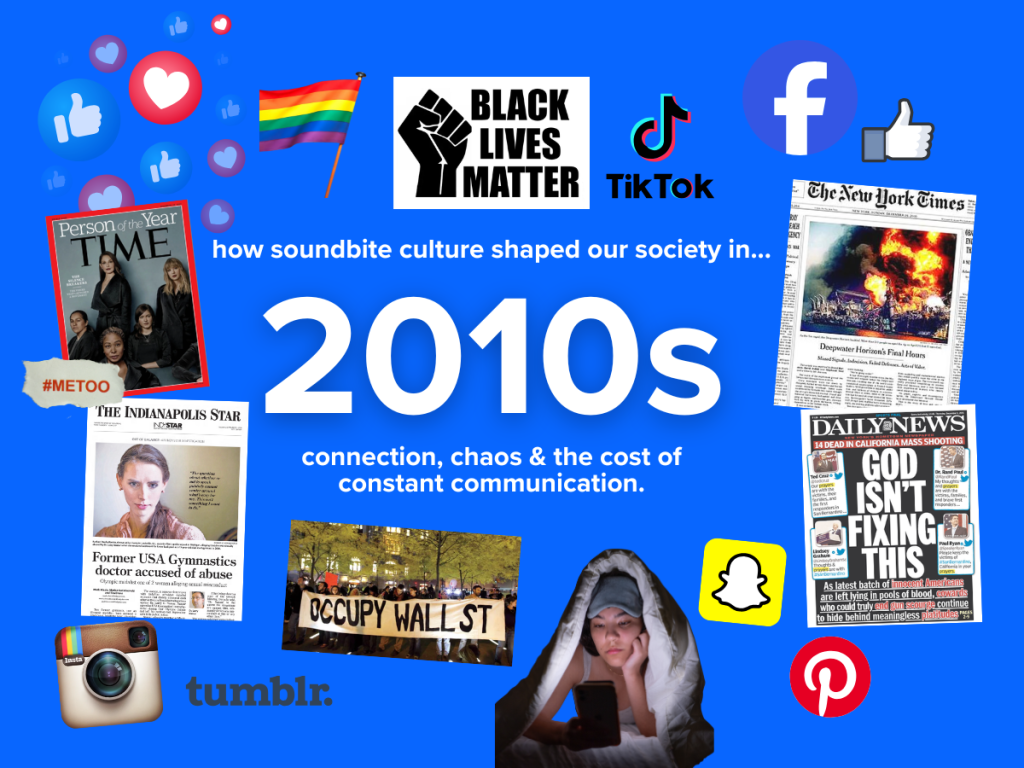
This piece is the fourth in a five-part series tracing the evolution of soundbite culture and how it’s shaped the way we consume information, debate ideas, and trust (or don’t trust) the media. Each decade tells a different part of the story. This series starts with the 1980s, when political campaigns, corporate advertising, and media consolidation collided to shrink our attention spans post-Cronkite era journalism. From there, I’ll look at the 1990s tabloid boom and reality-TV era, the rise of the internet in the 2000s, the weaponization of social media in the 2010s, and finally, the TikTok-brain algorithm-driven attention economy of today. Together, these chapters reveal not only how our media ecosystem has transformed, but how it’s changed our society and psychology at the same time.
When the world started to revolve around social media
The 2000s gave us social media, but the 2010s turned it into our lifestyle. This decade was relentless. The first period in time to unfold entirely online, it compressed breaking news, political crises, social movements, and mass tragedy into a single endless scroll. Platforms like Facebook, Tumblr, Twitter, Pinterest, YouTube, and later Instagram, Snapchat, and TikTok stopped being fun add-ons and morphed into a full-blown operating system for modern life. By 2012, about half (46%) of all Americans were getting news digitally, and 41% used social networking sites daily, according to Pew Research. Among adults under 30, a third (33%) were seeing news on social media, nearly the same (34%) as those watching it on TV.
By the end of the decade, Pew Research data from 2018 showed 20% of Americans primarily got their news from social media, surpassing print newspapers (16%) for the first time ever. This not only represented a shift in technology, but our psychology as well. We stopped visiting the internet and started living inside it. Each notification became a hit of dopamine, a micro-adrenaline rush; each tweet, a spark in a wildfire of public reaction. By 2020, that ecosystem had become the primary stage for everything, from protests to policy.
The defining moments we witnessed in real time
The 2000s primed us for chaos. So, by the 2010s, we were already desensitized. We had become conditioned to expect crisis after crisis, dramatic headline after dramatic headline. But what made this decade different wasn’t just how much was happening; it was how much we saw. For the first time, nearly everything, from natural disasters to mass tragedies to political revolutions, unfolded in real time on screens we carried in our pockets. What once reached us through the morning paper or the six o’clock news now arrived instantly, through push notifications and viral clips. The world didn’t just speed up; it became hyper-visible.
That visibility felt like power. We believed we were more informed, more connected, and more capable of shaping history than ever before. But in hindsight, much of that power was performative. It was more participation theater than actual influence. We felt like we were part of the conversation, when often, we were just reacting to it…while someone else profited from keeping our eyeballs glued to the screen.
Read the full blog on the Bite Back Substack.
 Amy Koczera: Strategic Writer & Storyteller
Leave a comment