Category: Blogging

This section features personal essays written for my personal Substack blog, The Bite Back. These pieces explore my personal perspectives navigating life after journalism, the search for meaning in modern work, and the process of reclaiming creativity and building confidence during career evolution.

  • The Bite Back: Buried leads: Stories you may have missed up to November 28, 2025

    The Bite Back: Buried leads: Stories you may have missed up to November 28, 2025

    A monthly summary highlighting stories that might have missed your newsfeed.
    The algorithm may show you the news, but that doesn’t mean you’re seeing every story. Compiled regularly by analyzing news coverage from multiple different outlets, this series highlights the headlines that you may have missed but shouldn’t overlook.

    For a regular update on top stories, check out the Stories behind the soundbites.

    1. National Guard shooting raises conflicting claims about refugee screening, casts spotlight on both Biden and Trump era immigration policy: “The D.C. National Guard shooting suspect was not an undocumented immigrant. He was a long-vetted CIA partner, screened repeatedly by U.S. intelligence, and legally admitted through a rigorous process overseen by both major parties.” –Aaron Parnas, Independent Journalist
    • A shooting that targeted two National Guard members in Washington, D.C. has triggered a nationwide clash over immigration policy, vetting standards, and the spread of false information. While the White House linked the attack to failures in refugee screening and moved to restrict immigration from multiple countries, intelligence records show the suspect, Afghan national Rahmanullah Lakanwal, had worked with the CIA and cleared extensive vetting by the administration. Critics accuse political leaders of pushing misleading claims that he was an undocumented or unvetted migrant, warning that the narrative is being weaponized to justify sweeping crackdowns on Afghan refugees. Supporters of stricter policies argue the rushed 2021 evacuation (Operation Allies Refuge) created unavoidable blind spots. The incident has become a point of conversation at the intersection of national security and refugee resettlement.
    1. New Epstein files trigger political infighting, misinformation battles, and fierce backlash from victims over botched redactions: “As soon as the legacy media suddenly started caring about it, and only about one person in particular, it became sus to MAGA,” –Raheem Kassam, Editor-in-Chief of The National Pulse
    • A massive release of Jeffrey Epstein–related documents has ignited political turmoil, misinformation disputes, and outrage from victims after dozens of un-redacted survivor names were mistakenly exposed. Democrats and some Republicans are pushing for full transparency, while MAGA figures who once demanded the Epstein files be released are now downplaying or dismissing revelations that include emails in which Epstein claimed Trump “knew about the girls.” At the same time, attorneys for victims are condemning the Justice Department for failing to protect survivors’ identities, warning that the redaction failures have caused panic and violate long-promised safeguards. The DOJ, facing a December deadline to release hundreds of thousands more records, has been ordered by a federal judge to explain its vetting and redaction process amid concerns of incompetence or political maneuvering. The unfolding controversy now spans victim privacy protection, political spin, and competing narratives over what the Epstein files actually reveal.

    Read the full blog on the Bite Back Substack.

  • The Bite Back: Stories behind the soundbites: November 12, 2025

    The Bite Back: Stories behind the soundbites: November 12, 2025

    From the 43-day U.S. government shutdown to global unrest in Gaza, Ukraine, and beyond, this week’s headlines reveal a world where power is traded for optics and leadership for leverage.

    Do you get your news from social media and want to stay informed, but without all the doomscrolling? Do you want to hear from all sides, but there isn’t one place that gives you everything you need?

    Welcome to the Stories Behind the Soundbites: a series dedicated to unpacking the big picture trends shaping each week’s headlines from multiple perspectives. Each blog breaks down the headlines dominating your feeds, how they’re being spun from different sides, and what they really say about the world we’re building.

    Thanks for reading the Bite Back! Subscribe for free to receive new posts and support my work.

    Politics: Shutdown may be over, but America’s divide widens

    After over 40 days of paralysis, Congress has finally voted to reopen the government, but the damage to public trust and essential services runs deep. The Senate passed a deal 60–40 to fund the government through January 2026, ending the longest shutdown in U.S. history and unlocking overdue SNAP payments for 42 million Americans. While those benefits will be issued retroactively, many families are still waiting. Some states have processed partial allocations under emergency court orders, while others have distributed nothing yet. The Supreme Court extended an order blocking full SNAP disbursements through Thursday night, leaving millions uncertain about when their grocery aid will actually arrive. Even after the funding deal, officials warn it could take weeks for federal and state agencies to return to normal operations, and longer still to restore confidence that safety-net programs are stable.

    The shutdown’s ripple effects have also reached the skies. Transportation Secretary Sean Duffy confirmed that the FAA is slashing flight operations at 40 major U.S. airports as it recovers from weeks of disruption. As of Tuesday morning, over 1,100 flights were canceled and 600 delayed nationwide. The FAA began cutting flights by 4% last Friday, expecting reductions to climb to 10% if staffing and scheduling challenges persist. The agency plans to reassess later this week as air traffic controllers and safety inspectors return to work, but uncertainty looms. The mass cancellations have left travelers stranded and airlines scrambling to cover shortages, providing a visible reminder that shutdowns don’t end neatly once funding resumes. And in a move emblematic of Washington’s shifting priorities, the funding bill also preserves $200 million in private donations earmarked for the construction of a new White House ballroom.

    Republicans also successfully blocked efforts to extend Affordable Care Act subsidies unless abortion restrictions were added, a demand Democrats condemned. Majority Leader John Thune inserted a last-minute provision allowing senators to sue the federal government for $500,000 if their phone records are seized, an act Democrats say undermines transparency and accountability.

    Beyond Washington, the political landscape continues to shift. A Utah judge struck down the GOP’s gerrymandered map, giving Democrats their first safe congressional seat in the state in years. Anti-abortion groups announced an $80 million plan to influence the 2026 midterms, and JFK’s grandson Jack Schlossberg entered the race for New York’s 12th District. Newly released Epstein-Maxwell emails alleging Trump’s knowledge of Epstein’s conduct have reignited congressional scrutiny and public outrage.

    The takeaway: The mechanics of democracy break down under partisan strain.

    The shutdown’s end offers relief, not resolution. Federal workers will finally be paid, flights will slowly resume, and food aid will begin to flow again…but the underlying instability remains. The crisis exposed just how brittle the machinery of American governance has become, where essential programs and public safety can be held hostage to partisan brinkmanship. SNAP recipients, air travelers, and federal employees alike now face the same uneasy question: if one standoff can paralyze the system like this, what’s to stop it from happening again?

    What was once a budget impasse has evolved into a reflection of how power, ideology, and personal grievance have replaced compromise as Washington’s currency. The shutdown showed that the real cost of political theater isn’t just delayed paychecks or canceled flights; it’s the erosion of trust in institutions meant to serve the people. Even as government doors reopen, the uncertainty lingers: whether it’s food on the table, healthcare access, or confidence in leadership, Americans are realizing that an ‘open’ government no longer means stable, accountable, or united.

    Read the full blog on the Bite Back Substack.
  • The Bite Back: Part 4: How soundbite culture has shaped our society

    The Bite Back: Part 4: How soundbite culture has shaped our society

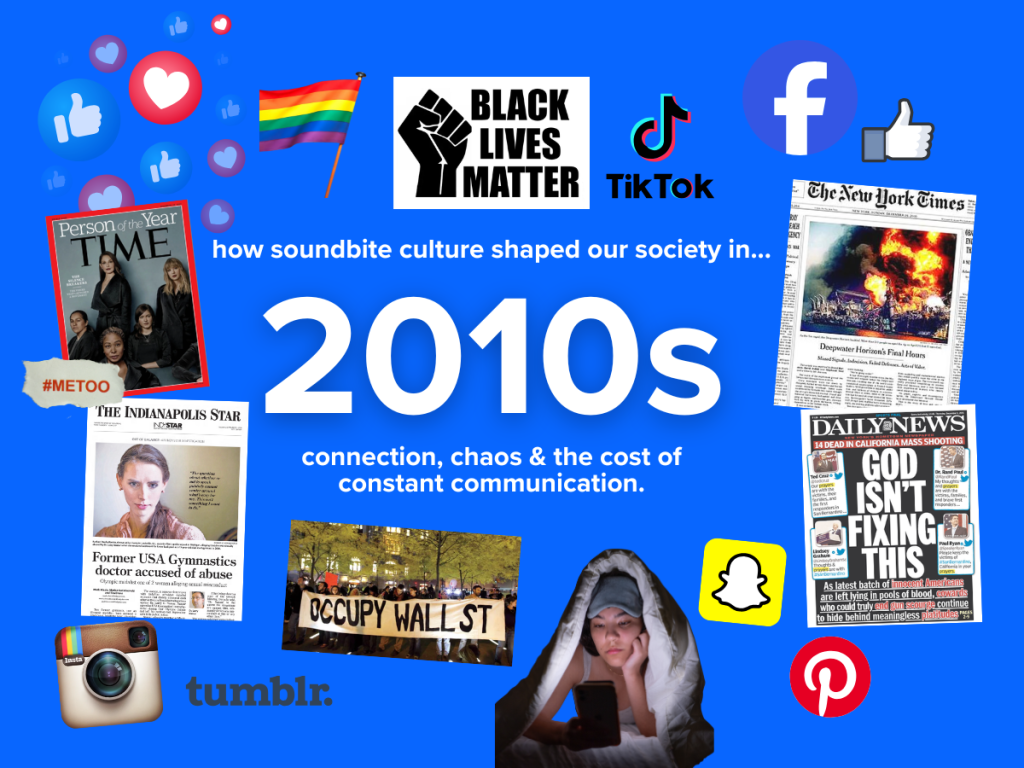
    The 2010s: Connection, chaos, and the cost of constant communication

    This piece is the fourth in a five-part series tracing the evolution of soundbite culture and how it’s shaped the way we consume information, debate ideas, and trust (or don’t trust) the media. Each decade tells a different part of the story. This series starts with the 1980s, when political campaigns, corporate advertising, and media consolidation collided to shrink our attention spans post-Cronkite era journalism. From there, I’ll look at the 1990s tabloid boom and reality-TV era, the rise of the internet in the 2000s, the weaponization of social media in the 2010s, and finally, the TikTok-brain algorithm-driven attention economy of today. Together, these chapters reveal not only how our media ecosystem has transformed, but how it’s changed our society and psychology at the same time.

    When the world started to revolve around social media

    The 2000s gave us social media, but the 2010s turned it into our lifestyle. This decade was relentless. The first period in time to unfold entirely online, it compressed breaking news, political crises, social movements, and mass tragedy into a single endless scroll. Platforms like Facebook, Tumblr, Twitter, Pinterest, YouTube, and later Instagram, Snapchat, and TikTok stopped being fun add-ons and morphed into a full-blown operating system for modern life. By 2012, about half (46%) of all Americans were getting news digitally, and 41% used social networking sites daily, according to Pew Research. Among adults under 30, a third (33%) were seeing news on social media, nearly the same (34%) as those watching it on TV.

    By the end of the decade, Pew Research data from 2018 showed 20% of Americans primarily got their news from social media, surpassing print newspapers (16%) for the first time ever. This not only represented a shift in technology, but our psychology as well. We stopped visiting the internet and started living inside it. Each notification became a hit of dopamine, a micro-adrenaline rush; each tweet, a spark in a wildfire of public reaction. By 2020, that ecosystem had become the primary stage for everything, from protests to policy.

    The defining moments we witnessed in real time

    The 2000s primed us for chaos. So, by the 2010s, we were already desensitized. We had become conditioned to expect crisis after crisis, dramatic headline after dramatic headline. But what made this decade different wasn’t just how much was happening; it was how much we saw. For the first time, nearly everything, from natural disasters to mass tragedies to political revolutions, unfolded in real time on screens we carried in our pockets. What once reached us through the morning paper or the six o’clock news now arrived instantly, through push notifications and viral clips. The world didn’t just speed up; it became hyper-visible.

    That visibility felt like power. We believed we were more informed, more connected, and more capable of shaping history than ever before. But in hindsight, much of that power was performative. It was more participation theater than actual influence. We felt like we were part of the conversation, when often, we were just reacting to it…while someone else profited from keeping our eyeballs glued to the screen.

    Read the full blog on the Bite Back Substack.