Category: Blogging

This section features personal essays written for my personal Substack blog, The Bite Back. These pieces explore my personal perspectives navigating life after journalism, the search for meaning in modern work, and the process of reclaiming creativity and building confidence during career evolution.

  • The Bite Back: Part 3: How soundbite culture has shaped our society

    The Bite Back: Part 3: How soundbite culture has shaped our society

    The 2000s: Clickbait, bloggers, and the fall of the old news order
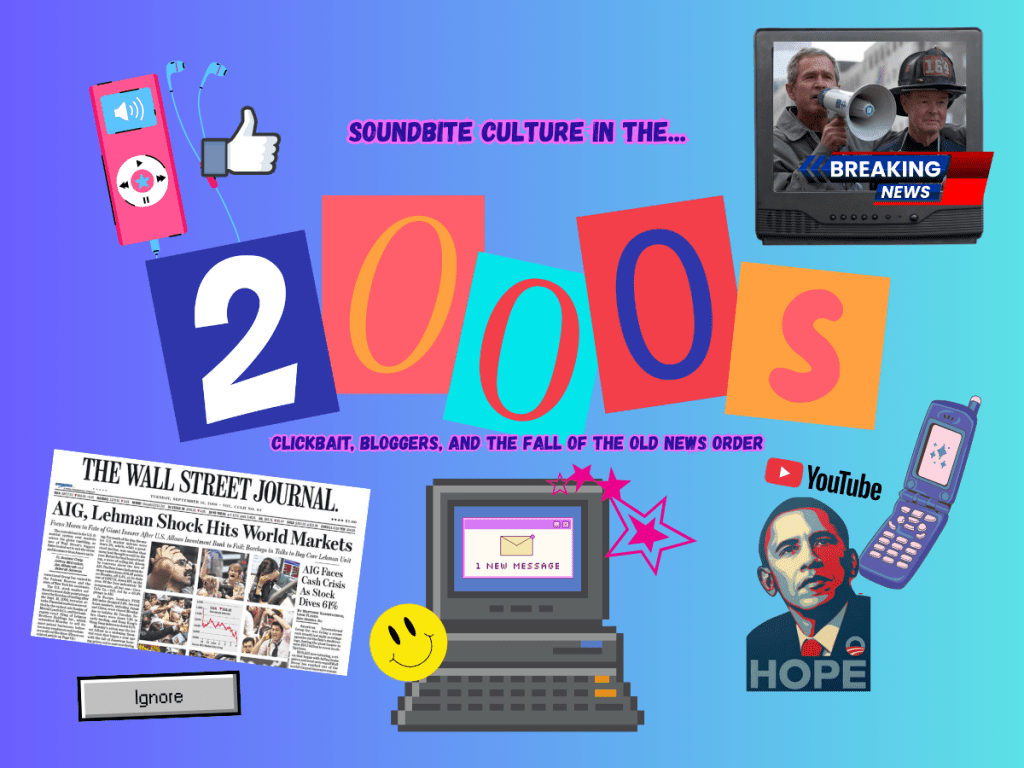
    This piece is the third in a five-part series tracing the evolution of soundbite culture and how it’s shaped the way we consume information, debate ideas, and trust (or don’t trust) the media. Each decade tells a different part of the story. This series starts with the 1980s, when political campaigns, corporate advertising, and media consolidation collided to shrink our attention spans post-Cronkite era journalism. From there, I’ll look at the 1990s tabloid boom and reality-TV era, the rise of the internet in the 2000s, the weaponization of social media in the 2010s, and finally, the TikTok-brain algorithm-driven attention economy of today. Together, these chapters reveal not only how our media ecosystem has transformed, but how it’s changed our society and psychology at the same time.

    Digital media and the Internet take over

    The 1990s introduced spectacle as the organizing principle of modern media. By the early 2000s, the pace had gone into overdrive. With the machine of the 24-hour news cycle constantly churning in the background, cable networks filled every minute with wall-to-wall coverage, punctuated by punditry, speculation, and looping graphics designed to keep viewers agitated and engaged.

    The real shift of the decade came with the Internet boom and the rise of digital outlets that could move faster and cheaper than newspapers or TV. Blogs and early online publications competed for our attention, pumping out a steady stream of fresh content everyday. Audiences came to expect real-time updates, and the stories dramatic enough to draw clicks often dictated what rose to the top of the mainstream news agenda.

    While many new forces played a role in shaping the media landscape of the early 2000s, we have to start by talking about one unimaginable and tragic event that redefined the news cycle and set in motion years of coverage, reframing how global events were reported–especially by American media: September 11, 2001.

    Read the full blog on the Bite Back Substack.
  • The Bite Back: How the #HireAJournalist initiative is writing the media industry’s next chapter

    The Bite Back: How the #HireAJournalist initiative is writing the media industry’s next chapter

    Ex-journalists should be thriving outside the newsroom, what’s stopping them?

    It’s no secret the journalism industry has been struggling to find its place in the modern media world. Once viewed as a credible and admirable line of work, the profession is now often weaponized – used to prove credibility in one breath and discredited in the next. The version of journalism I grew up believing in feels like it no longer exists, and with it, the place of the people who made it possible: journalists themselves.

    From the day I expressed interest in becoming a journalist, before I even started high school, I was told the career would be a sacrifice. This was reinforced in all my undergrad journalism classes. The low pay, the long hours, the missed holidays, the unpaid overtime – none of that came as a surprise. What drew me in was the mission. In the same way teachers or doctors feel called to serve, I felt called to journalism as my purpose in life. I felt that reporting the news and investigating stories to inform local communities was part of a greater mission to serve the greater good. I knew it wouldn’t be easy, but I believed it would be worth it.

    What I didn’t realize until I was in the field was that the “greater mission” I believed in was more complicated than any college class, freelance job, or internship could have prepared me for. The media industry itself was changing faster than any syllabus could keep up with. Newsrooms were shrinking, social media algorithms becoming more sophisticated, and the entire legacy news system was on a downward spiral–slowly transforming into something unrecognizable from what we idolized in the Cronkite-era.

    As a result, over four years ago, I walked away from what I thought was my dream job as a multimedia journalist. I didn’t leave because I wasn’t cut out for it. I left because of disillusionment and disappointment. Every day, I faced accusations from friends, family members, and strangers in comments sections that I was pushing “fake news.” I endured politicians ridiculing reporters, myself included, for asking tough questions, and watched the public cheer them on. Meanwhile, unverified “influencer” accounts and social media algorithms fed audiences a steady stream of outrage and half-truths, eroding trust in both outlets and the journalists inside them.

    Today, no one consumes news the way they did when I fell in love with the industry over 15 years ago. The shared-experience of the nightly news and centralized model of mainstream media has collapsed, replaced by personalized “news” feeds. The dangers of this new media world are obvious to those who created it and lived inside of it, but invisible to those consuming it: polarization, disinformation, and deeper societal division.

    Read the full blog on the Bite Back Substack.
  • The Bite Back: Part 2: How soundbite culture has shaped our society

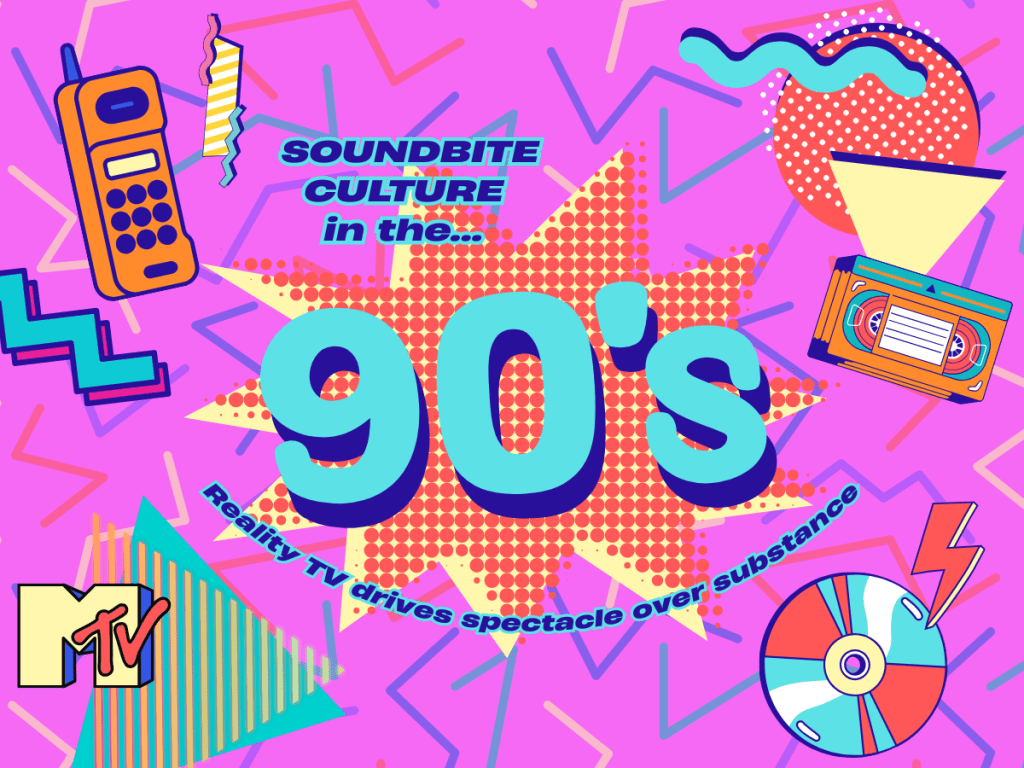
    The Bite Back: Part 2: How soundbite culture has shaped our society

    The 1990s: Reality TV drives spectacle over substance

    This piece is the second in a five-part series tracing the evolution of soundbite culture and how it’s shaped the way we consume information, debate ideas, and trust (or don’t trust) the media. Each decade tells a different part of the story. This series starts with the 1980s, when political campaigns, corporate advertising, and media consolidation collided to shrink our attention spans post-Cronkite era journalism. From there, I’ll look at the 1990s tabloid boom and reality-TV era, the rise of the internet in the 2000s, the weaponization of social media in the 2010s, and finally, the algorithm-driven attention economy of today. Together, these chapters reveal not only how our media ecosystem has transformed, but how it’s changed our society and psychology at the same time.

    When news started borrowing from entertainment

    The 1980s gave us the political catchphrase and the corporate slogan, but the 1990s capitalized on sensationalism and added to the spectacle. The culmination of the 24 hours news cycle, reality TV, tabloid journalism, and cable news both shortened and dramatized the already condensed message. Suddenly, the clip that was used to get audiences to tune in wasn’t just about brevity, it was about encapsulating and heightening the conflict, turning every tear, scream, or zinger into a must-see moment replayed again and again. The soundbite evolved from a tool to condense politics and ads into a formula that would shape the future of media consumption forever. Traditional journalists were both reporting on reality and competing with it, blurring the line between information and entertainment.

    From regulation to deregulation: How policy set the stage

    The rise of spectacle-driven news in the 1990s wasn’t only driven by audience appetite. It was enabled by a major shift in U.S. media policy. Over the last half of the 20th century, the federal government’s stance on media ownership and regulation flipped from protecting diversity to embracing deregulation in the name of competition. The market changed drastically over this time, so let’s take a look at some of the factors behind this shift leading up until the 1990s.

    Safeguards for diversity

    In the 1970s, the FCC treated media diversity as essential for democracy. The Fairness Doctrine, introduced in 1949, required broadcasters to air controversial issues and include contrasting viewpoints. So, by the ‘70s, this created a perceived sense of balance in news coverage, with 72% of Americans trusting that the media reported “fully, accurately, and fairly” in 1976, according to Gallup. However, around this time, critics began to argue that the doctrine chilled free speech and discouraged coverage of divisive topics to avoid conflicts with regulators. Meanwhile, cross-ownership bans also kept newspapers and local stations from falling under the same owner, while the FCC’s financial interest and syndication rules (aka fin-syn rules) prevented the big three TV networks (ABC, CBS, NBC) from owning or profiting too heavily from the syndication of shows they aired.

    Deregulation takes hold

    By the early 1980s, the balance struck in the previous decades was starting to unravel. For audiences, rules like the Fairness Doctrine and fin-syn had fostered a sense of impartiality and trust in the news. But for broadcasters and policymakers aligned with the Reagan administration, these same rules were viewed as outdated barriers to competition and profit. Reagan’s FCC chairman, Mark Fowler, captured this new philosophy when he declared that television was nothing more than “a toaster with pictures,” implying that it was a consumer product, no longer just a tool for communication. This ushered in a wave of deregulation. The Fairness Doctrine was repealed in 1987, enabling the rise of partisan talk radio and less regulated political commentary. The industry quickly recalibrated, shifting its focus from serving a broad public to serving segmented audiences and advertisers.

    Read the full blog on the Bite Back Substack.